
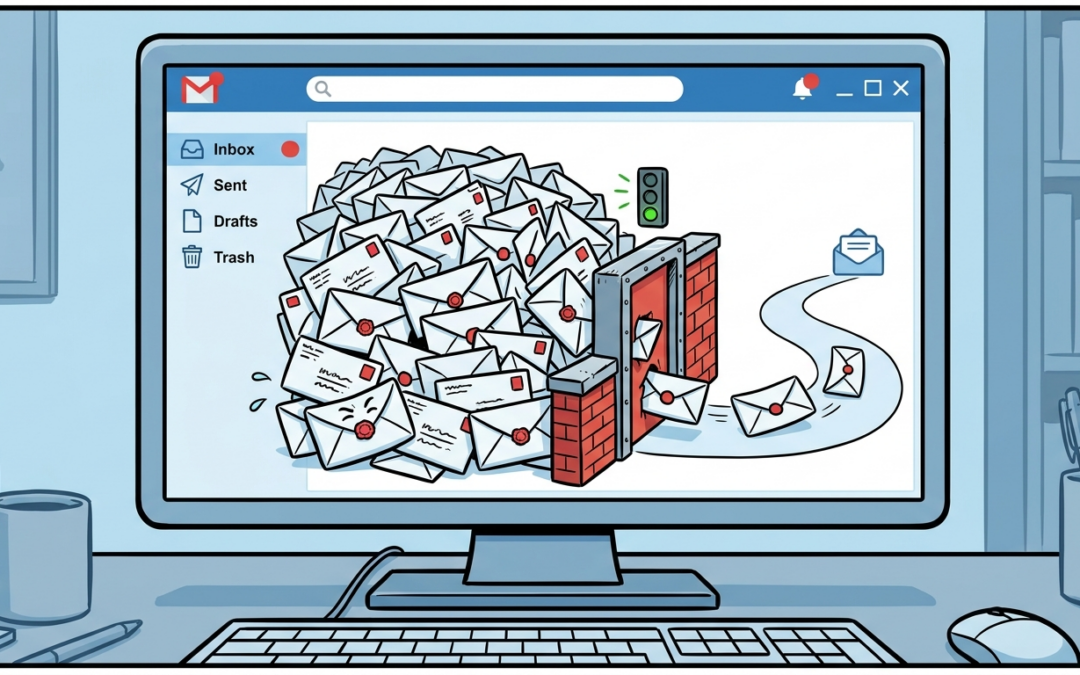
Whether a press release actually reaches a larger number of recipients is often decided even before it is sent—namely when choosing the mail server. Standard mail servers, as used in most companies anyway, were developed for everyday email traffic, not for sending to large distribution lists at the same time. This is exactly what quickly causes problems when sending personalised press releases.
The hidden cost of standard mail servers
Free or low-cost mail servers sound tempting. But what you save at first glance costs you elsewhere. Microsoft 365, Google Workspace, or basic email solutions from traditional hosting providers are not designed for personalised bulk sending. This becomes apparent, among other things, in the lack of dedicated IP addresses. These are IP addresses reserved exclusively for your own sending and not shared with other users. In addition, there are strict sending limits that cannot be customised. Those who opt for a free or low-cost provider may save on licence fees, but often have to accept poorer deliverability and a higher spam risk. In the worst case, press releases will not reach all recipients.
Restrictions that apply to everyone—and are non-negotiable
The limits of many well-known mail servers are global and cannot be changed, even for an additional fee. Many PR agencies and press offices use simple standard mail servers where the limits are particularly strict. Often, the sending limit is already just a few hundred emails per day. Exchange Online users have more leeway, but Microsoft sets fixed limits here as well. Per mailbox, within 24 hours, messages may be sent to a maximum of 10,000 recipients, internal and external combined.
Even more decisive in day-to-day work is a second limit. Per minute, the server allows a maximum of 30 emails through. If this rate is exceeded, the remaining messages are not rejected immediately, but delayed and distributed across the following minutes. However, if the daily recipient limit of 10,000 is exceeded, the server completely rejects further deliveries for that day. For smaller agencies, this may initially seem sufficient, but the real problem is not just the numbers—it is that standard mail servers are simply not suitable for personalised bulk sending. In addition, the limits mentioned apply equally to all users and cannot be customised, regardless of how large the company is or how much one is willing to pay.
For PR agencies and press offices, this means that a press release that has been carefully written and sent to dozens of editorial teams may be sent with significant delay, may not arrive, or may not be sent at all.
When mail servers become the problem themselves
The behaviour of receiving mail servers is an issue that often does not receive enough attention. Anyone who regularly sends press releases to large distribution lists will find that some recipients do not open the emails. This is part of normal sending routines and can hardly be avoided. It becomes problematic when recipients respond very little to emails from a particular sender address over a longer period of time. Recipient-side mail servers now evaluate numerous signals to assess a sender’s trustworthiness. These can include interactions such as opening emails, deleting messages, or spam complaints by the recipient. If a sender’s reputation deteriorates over time, further messages from that address are often evaluated more critically and are more likely to end up in the spam folder. This happens automatically, without warning, and in the worst case can mean that future mailings reach recipients significantly less reliably.
Anyone using a standard mail server generally has no insight into such processes. Even specialised providers can never say with absolute certainty whether an email actually arrived—this simply depends on the receiving server. With standard mail servers, however, there is also no feedback on whether an address may already be permanently blocked. As a result, the problem often goes unnoticed for a long time.
Standard mail servers were never built for this purpose
Standard mail servers are also not suitable for professional press work due to their technical design. Their servers and sending routes are fundamentally built more for personal or everyday business communication with individual recipients, not for sending to hundreds of addresses at the same time. Microsoft itself points out that customers should use a specialised provider when sending larger volumes to external recipients.
Dedicated relay servers designed for bulk sending solve exactly these problems. They provide dedicated IP addresses and targeted configuration via SPF, DKIM, and DMARC. These authentication methods significantly reduce the risk of messages being classified as spam from the outset.
What makes the difference
Anyone who wants to solve the issues mentioned in the long term should clearly separate sending and management. The structure is handled by PressFile. Contacts can be managed by region, topic, or media type; distribution lists can be created in advance and used in a targeted way. Every mailing is documented, and the entire sending history can be tracked at any time.
The actual sending is handled via a dedicated relay server or smarthost, which the customer can choose themselves if they wish. The requirements for personalised press release sending have increased. A structured PR tool like PressFile for managing contacts, distribution lists, and sending histories, combined with a relay server specifically designed for bulk sending, makes the difference. Only those who bring both together are truly well equipped for the demands of today’s email communication.
The image used was generated with the help of Google Gemini.